
For people who decide what gets built

nobody can see what is in flight without asking each team
Nine organisations said this. Six of them were deals you lost.
Ordagrann reads every conversation your company has with customers and shows you which themes came up in the deals you lost, in the words they were said in.
Example figures. We will never tell you why you lost. We will tell you what they said before they went.

The argument
The request is never the need.
Customers are excellent at describing problems and terrible at designing solutions. That is not a criticism. You have information they do not.
When someone asks for a filter on the reports page, the request tells you almost nothing. The reason they asked, that they rebuild the same view by hand every Monday and no longer trust the numbers, tells you what to build, whether three other customers need it, and whether a filter is even the answer.
What they asked for
A filter on the reports page.
What they said
Every Monday I copy these numbers into a spreadsheet before our team call, and I am never sure I have caught everything.
How it works
From the calls you already record to a page someone can build from.
- 01
Say yes to each call
Ordagrann lists the meetings your notetaker recorded. You add the customer calls and skip the rest. Nothing is read before you say yes.
- 02
Every sentence that matters, kept
Everything a customer said about their work, a need or your product becomes a signal, with the exact sentence and who said it.
- 03
Grouped into themes
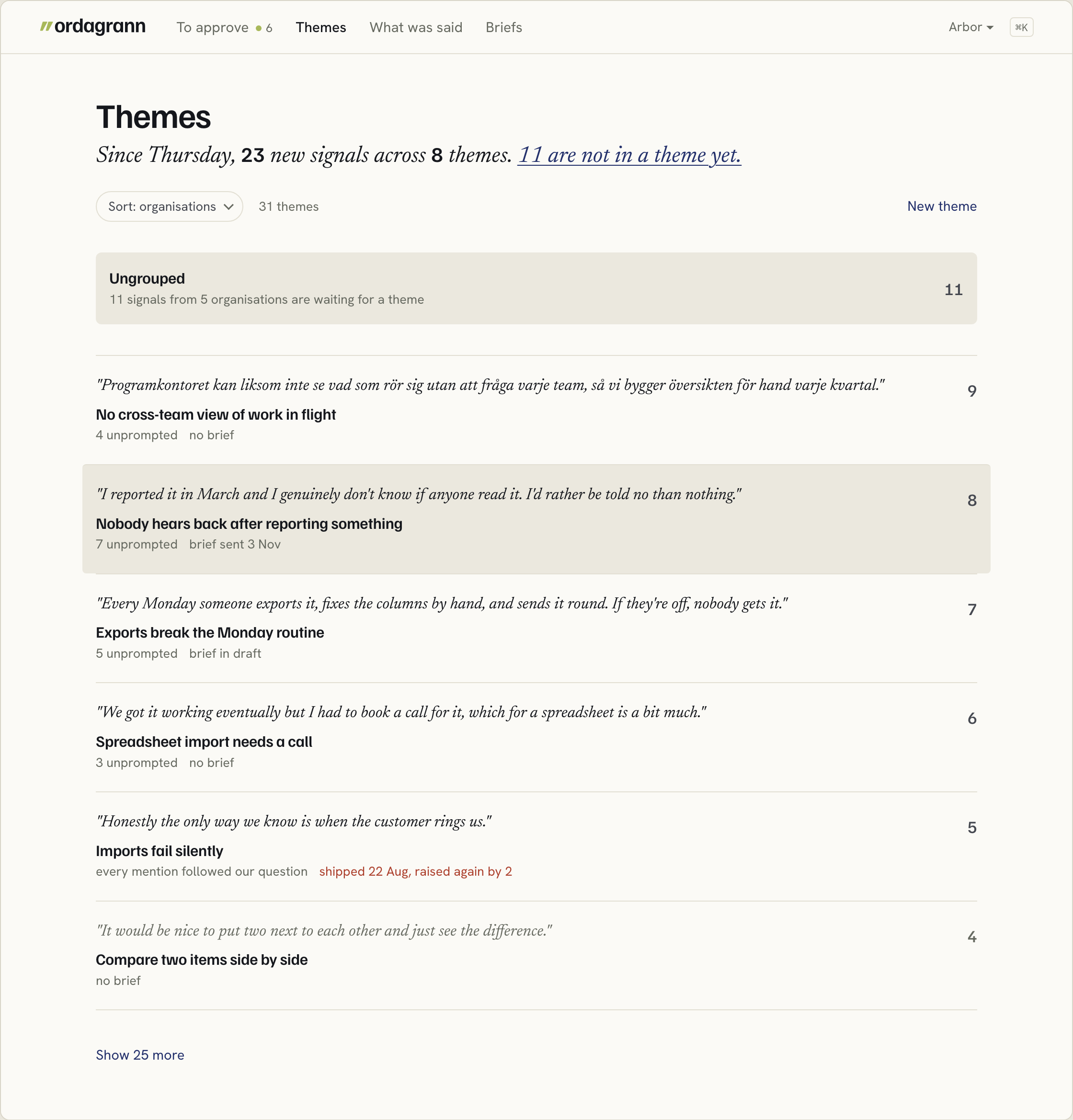
Signals are grouped by the struggle underneath them, and each theme is counted by organisation, with the unprompted ones apart.
- 04
A brief someone can build from
Turn a theme into one page: the evidence, locked, and your decision. Send it to whoever builds, no account needed to read it.
Numbers you can argue with
Built to be true, which means they are sometimes smaller.
Organisations, not mentions
One customer who brings it up in every call is one customer. Fourteen mentions from nine organisations reads as nine.
Unprompted counts apart
Half of a good discovery call is the seller proposing a need and the buyer agreeing. We count who raised it first, and lead with the ones nobody was asked about.
Every line has its quote
Nothing is asserted without the sentence behind it, in the language it was said in, clickable back to the call, the person and the date.
Won deals beside lost ones
Six of nine lost deals means little if eight of ten won deals said it too. The base rate is always on the screen.
What we will never build
Every one of these is something our competitors sell.
Shipping has never been cheaper. Choosing what to ship has never been more expensive, and that choice stays with people.
- No priority score. We count organisations. You decide.
- No agents writing your code or your launch copy. People decide what gets built. We make sure they have heard the customer first.
- No sync with your tracker. The brief is a page a person reads, not a ticket filed faster.
- No feedback from everywhere. Conversations only, because that is where people say why.
The method
How to hear your customers.
Seven rules for turning what customers say into what you build. They need no tool and take an hour a week. Ordagrann is that method made easy.
Read the guide
Early access
We are using it ourselves first.
Leave your email and we will write once, when it opens. The first fifty teams get half price for twelve months in exchange for a quote we can put here.